
E-signature legality · France
Are electronic signatures legal in France?
Reviewed
In short
Yes, generally. The French Civil Code gives an electronic document the same evidential value as paper when its author can be identified and its integrity is preserved, and recognizes electronic signatures that use a reliable identification process. Only a qualified electronic signature under eIDAS is presumed reliable; with a simple signature, the party relying on it may need to prove reliability if the signature is challenged. Some family-law and succession acts and notarial deeds follow their own form rules.
The law
Laws that apply
- 2016Code civil, articles 1366 and 1367
Art. 1366: electronic writing has the same evidential value as paper if the author is identified and integrity is preserved. Art. 1367: an electronic signature uses a reliable identification process linked to the act; reliability is presumed under conditions set by decree. Articles introduced by Ordonnance n° 2016-131.
Source: legifrance.gouv.fr
- 2021Code civil, articles 1174 and 1175 (version in force since 1 January 2022)
Art. 1174 lets electronic form satisfy a written-form requirement; art. 1175 excludes private acts relating to family law and succession, with a carve-out for certain lawyer-countersigned agreements.
Source: legifrance.gouv.fr
- 2017Décret n° 2017-1416 du 28 septembre 2017 relatif à la signature électronique
Grants the presumption of reliability under art. 1367 to qualified electronic signatures as defined by eIDAS.
Source: legifrance.gouv.fr
- 2014Regulation (EU) No 910/2014 (eIDAS), as amended by Regulation (EU) 2024/1183
Directly applicable in France: electronic signatures can't be refused as evidence solely because they are electronic; qualified signatures have the effect of a handwritten signature.
Source: eur-lex.europa.eu
Generally fine to sign electronically
- Commercial contracts, purchase orders and supplier agreements
- Employment contracts and HR documents, subject to any specific form rules
- Residential and commercial leases
- Consumer agreements and terms of service
- Security interests (sûretés) given outside a professional context, since the 2021 reform removed them from the art. 1175 exclusion
Exceptions and extra formalities
- Private acts under signature relating to family law and succession (Code civil art. 1175), except the lawyer-countersigned agreements the article carves back in
- Acts that must be made before a notary (acte authentique), such as sales of real property and certain marriage contracts, which follow notarial procedures
- Documents for which a specific statute requires a handwritten mention or particular form
- Filings with courts and public bodies that set their own electronic-submission rules
In practice
Things to know
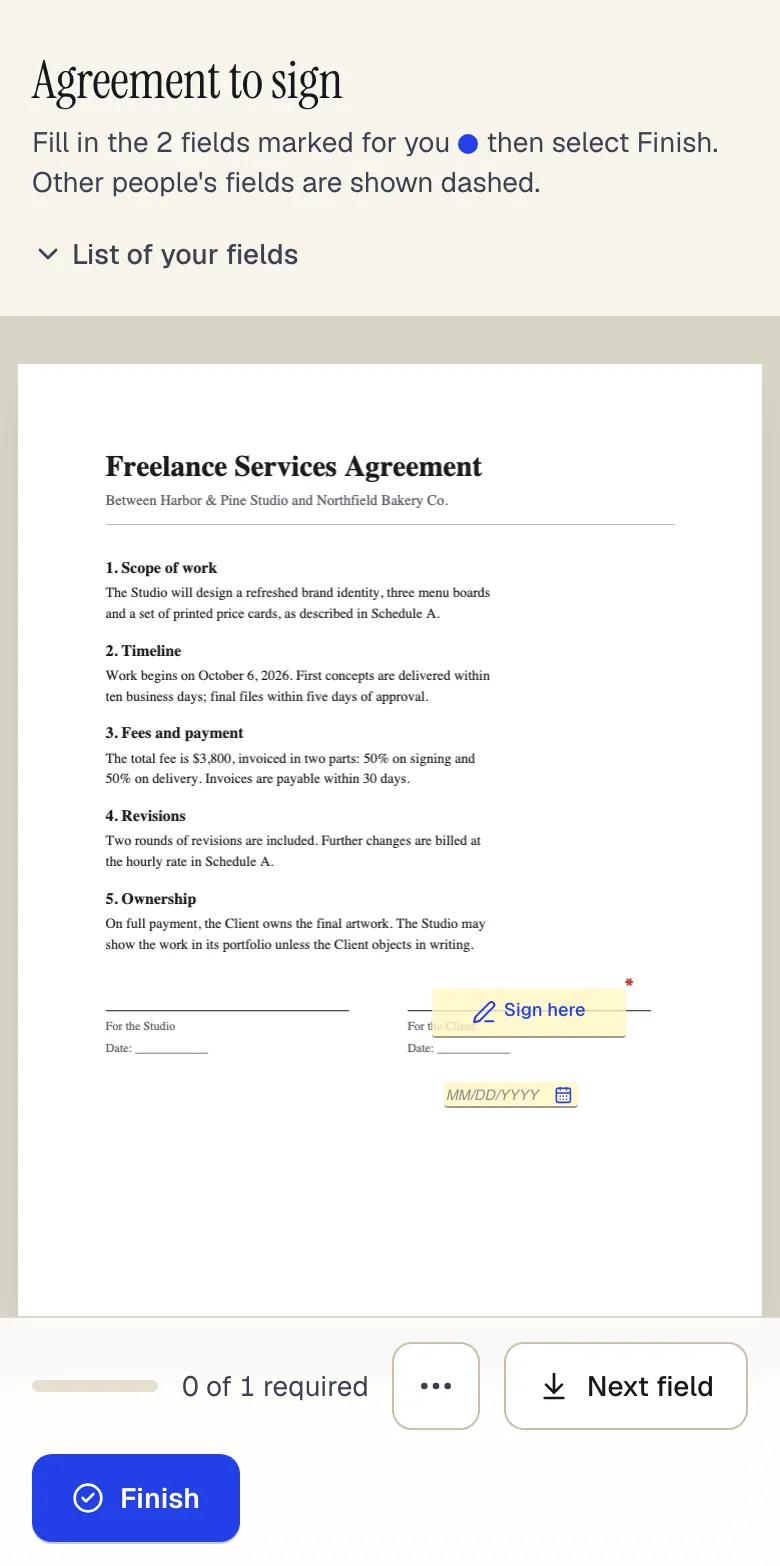
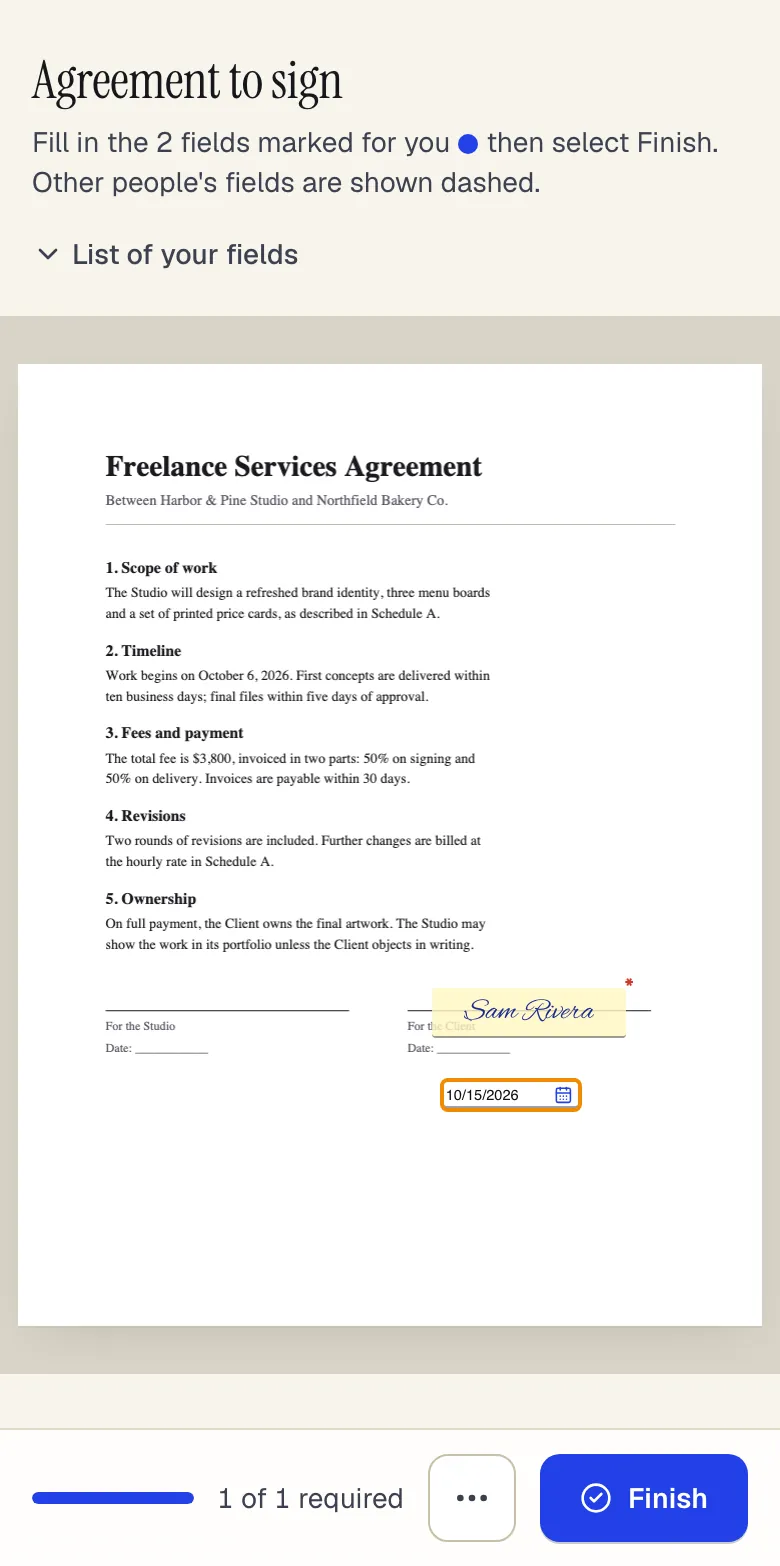
Every PDFBetter signer signs with their own cryptographic key: their browser generates an ECDSA P-256 key that never leaves the device and signs a statement binding the document's SHA-256 fingerprint to exactly what they entered, and PDFBetter's certificate authority certifies that key. Every completed PDF and its certificate of completion are digitally sealed with a PAdES signature and, when the service is reachable, independently time-stamped under RFC 3161, so any change shows in PDF readers. The evidence is built into the file: signed statements, device signatures, certificates, entered values and a hash-chained audit log of every view, consent, signature and decline with time and IP address. Signers consent to sign electronically first, the sender can require an emailed 6-digit code, and completed evidence is kept for 7 years. Signature requests are designed to the technical requirements of an advanced electronic signature (eIDAS art. 26): a unique key per signer, under their sole control, linked to the document so any change is detectable. Signers are identified by email (and an optional emailed code), not by ID documents or SMS.
In France the difference between a simple and a qualified signature is mainly about proof: a qualified signature is presumed reliable, while for any other signature the evidence (with PDFBetter, the evidence embedded in the sealed PDF and the certificate of completion) is what you would rely on if the signature were disputed.
PDFBetter does not create qualified electronic signatures (QES) and does not offer SMS codes, phone authentication, knowledge-based questions or government ID checks. Its seal certificate comes from PDFBetter's own certificate authority, not a government-accredited one, and is not yet on Adobe's trust list, so Acrobat shows the seal's identity as not verified while still detecting changes. Where a law requires a qualified or accredited signature, verified identity, a notary, wet ink or a witness, use a process that provides it.
This page summarizes what the law generally says, with links to the official texts. PDFBetter is not a law firm; for an important or unusual document, check with a lawyer qualified where the document will be relied on.
What PDFBetter gives you as evidence
Every signer signs with their own cryptographic key, bound to the document’s SHA-256 fingerprint, after recorded consent and an optional emailed code. The completed PDF and certificate of completion are digitally sealed and independently time-stamped, with the hash-chained audit trail built into the file. Designed to the technical requirements of an advanced electronic signature (eIDAS art. 26); signers are identified by email (and an optional emailed code), not by ID documents or SMS. Not a qualified signature (QES).
E-signatures in France: questions people ask
Is a simple electronic signature valid in France?
Generally yes. French law and eIDAS don't deny an electronic signature effect just because it isn't qualified. The difference is the burden of proof: only a qualified signature is presumed reliable.
When should I use a qualified signature in France?
When the document is high-stakes or likely to be contested, or when a law or counterparty requires the strongest presumption. Qualified signatures require identity verification by a qualified trust service provider.
Can a will be signed electronically in France?
No. Wills and other private acts relating to succession and family law are excluded from electronic form under art. 1175 of the Code civil.
Can I sign a property sale electronically?
Preliminary agreements are often signed electronically, but the final sale of real property is executed before a notary, who uses notarial procedures, including electronic notarial acts.
Does PDFBetter provide qualified signatures?
No. PDFBetter signature requests are designed to the technical requirements of an advanced electronic signature (eIDAS art. 26): a unique key per signer, under their sole control, linked to the document so any change is detectable. Signers are identified by email (and an optional emailed code), not by ID documents or SMS. Without a QES there is no presumption of reliability, so the embedded evidence and certificate of completion are what you would rely on if a signature were disputed.