
Medical Records Release Authorization
For patients who want a provider or health plan to send their records to someone else, such as a new doctor, attorney, insurer, school or family member, and for practices that need a general authorization form. Many organizations require their own form; state law may add requirements.
- Fields
- 42
- Pages
- 3
- Paper
- Letter
Fill it online without an account. The blank PDF is free to download and works in any PDF reader. Downloading a filled copy from the editor needs a free account — 3 downloads a month, no watermark. See plans
Reviewed
Before you start
What you need to fill it in
- Patient's name, date of birth and contact details
- The provider or plan that holds the records
- The person or organization receiving them
- Which records and date range
- Purpose ("at the request of the individual" is acceptable)
- Expiration date or event
What's inside
42 fields, ready to fill
- 24Typed answersnames, addresses, descriptions
- 5Dateschecked as real dates
- 8Choicescheckboxes, options, dropdowns
- 5Signaturessignature and initials
11 required — the editor counts down how many are left while you fill.
Instructions
How to fill out the Medical Records Release Authorization
- 1
Identify the patient
Enter the patient's full name, date of birth and contact details. Former names help the record holder find files.
- 2
Who releases and who receives
Enter the provider releasing the records and the recipient's name, address and fax or email.
- 3
Describe the information
Check the record types and enter a date range. Sensitive categories such as mental health, substance use treatment, HIV or genetic testing need a separate initial where state or federal law requires specific consent.
- 4
State purpose and expiration
Enter why the records are being shared and when this authorization ends.
- 5
Sign
The patient or personal representative signs and dates. A representative describes their authority.
Fill it online
What filling it looks like
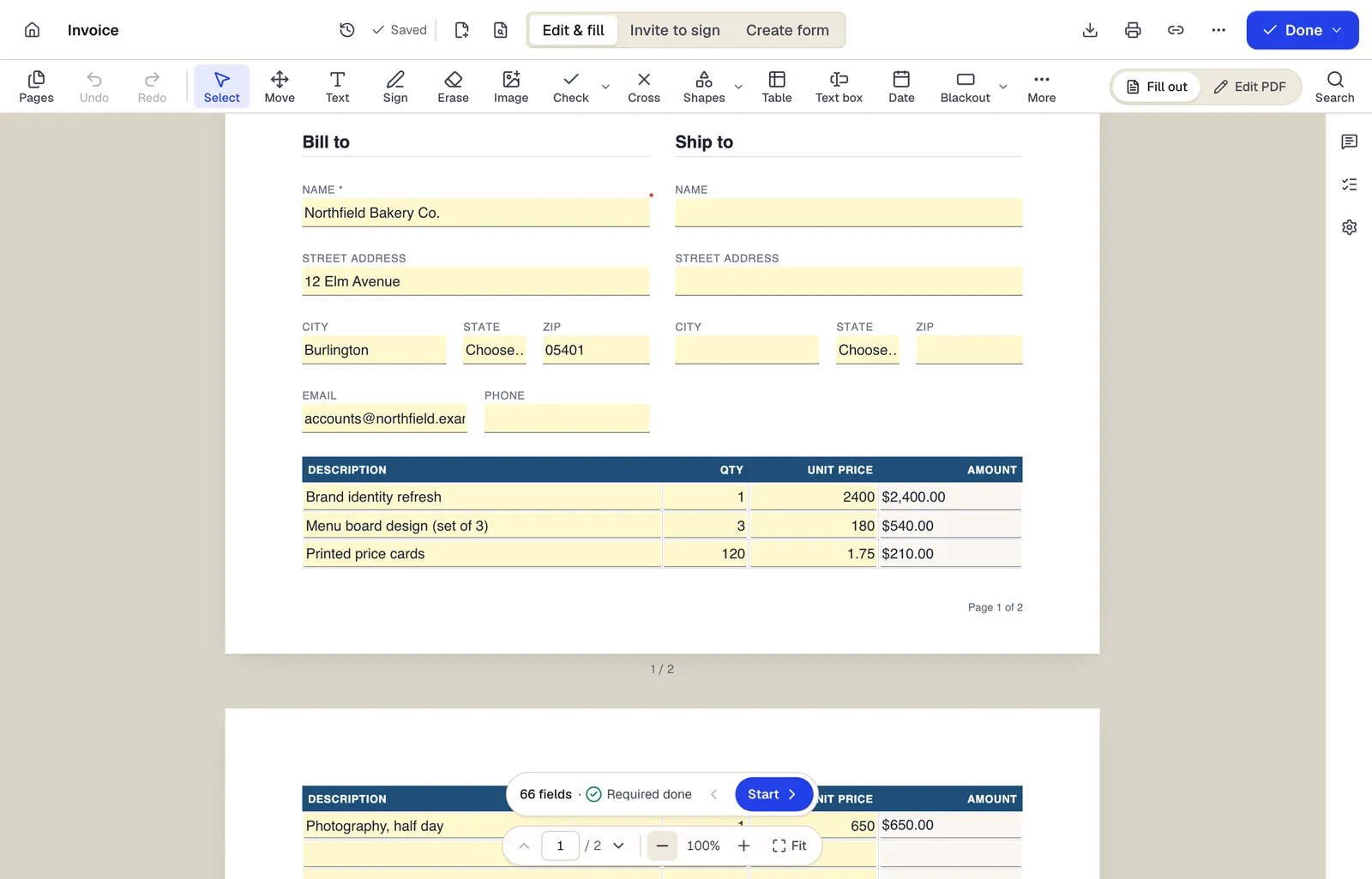
- Edit & fill, Invite to sign and Create form are three modes of the same editor
- Amounts are formula fields: they calculate as you type
- The field navigator counts what's left and jumps to the next field
Shown with our invoice template. Sample content; names are fictional.
Written for: General (US)
This template is a general starting point, not medical or legal advice. HIPAA, state privacy and consent rules vary; have your compliance lead or a qualified professional review it before use.
Written by PDFBetter and last reviewed October 15, 2026. Spotted a problem? Tell us.
Medical Records Release Authorization: questions people ask
Does this form satisfy HIPAA?
It includes the core elements and required statements in 45 CFR 164.508 for a valid authorization. Some providers insist on their own form, and state laws may require more, so check with the record holder.
Do I need an authorization to get my own records?
No. Under HIPAA's right of access you can request your own records directly, usually in writing. An authorization is for sending records to someone else.
Are psychotherapy notes included?
No. Psychotherapy notes require a separate authorization that cannot be combined with other authorizations, except another psychotherapy notes authorization.
Can I revoke it?
Yes, in writing, at any time, except for information already released in reliance on it. The form explains how.
Is an e-signature acceptable?
HIPAA allows electronic signatures on authorizations if they are valid under applicable law. Some record holders still require wet signatures or ID verification.
Does it need to be notarized?
HIPAA does not require notarization. Some record holders or state laws, especially for releases to attorneys, may ask for it.
Ready when you are
Fill the Medical Records Release Authorization now — no account to start.