
Guide · Tax forms
How to fill out Form W-9
Reviewed

Short answer
To fill out Form W-9, enter your name on line 1 (and a business or disregarded-entity name on line 2), check one federal tax classification on line 3a, complete line 3b only if it applies to your partnership, trust or estate, add any exemption codes on line 4, your address on lines 5–6, your SSN or EIN in Part I, then sign and date Part II. Give the form to the person or business that asked for it, not to the IRS. The current revision is dated March 2024.
On this page (6)
What Form W-9 is for
A W-9 gives a payer your correct taxpayer identification number (TIN) so they can report payments to you, for example on Form 1099-NEC for freelance work or Form 1099-INT for interest. Banks, brokers, clients and landlords commonly ask for one.
Only U.S. persons, including resident aliens, use Form W-9. The IRS instructions tell foreign persons not to use it and to provide the appropriate Form W-8 or Form 8233 instead.
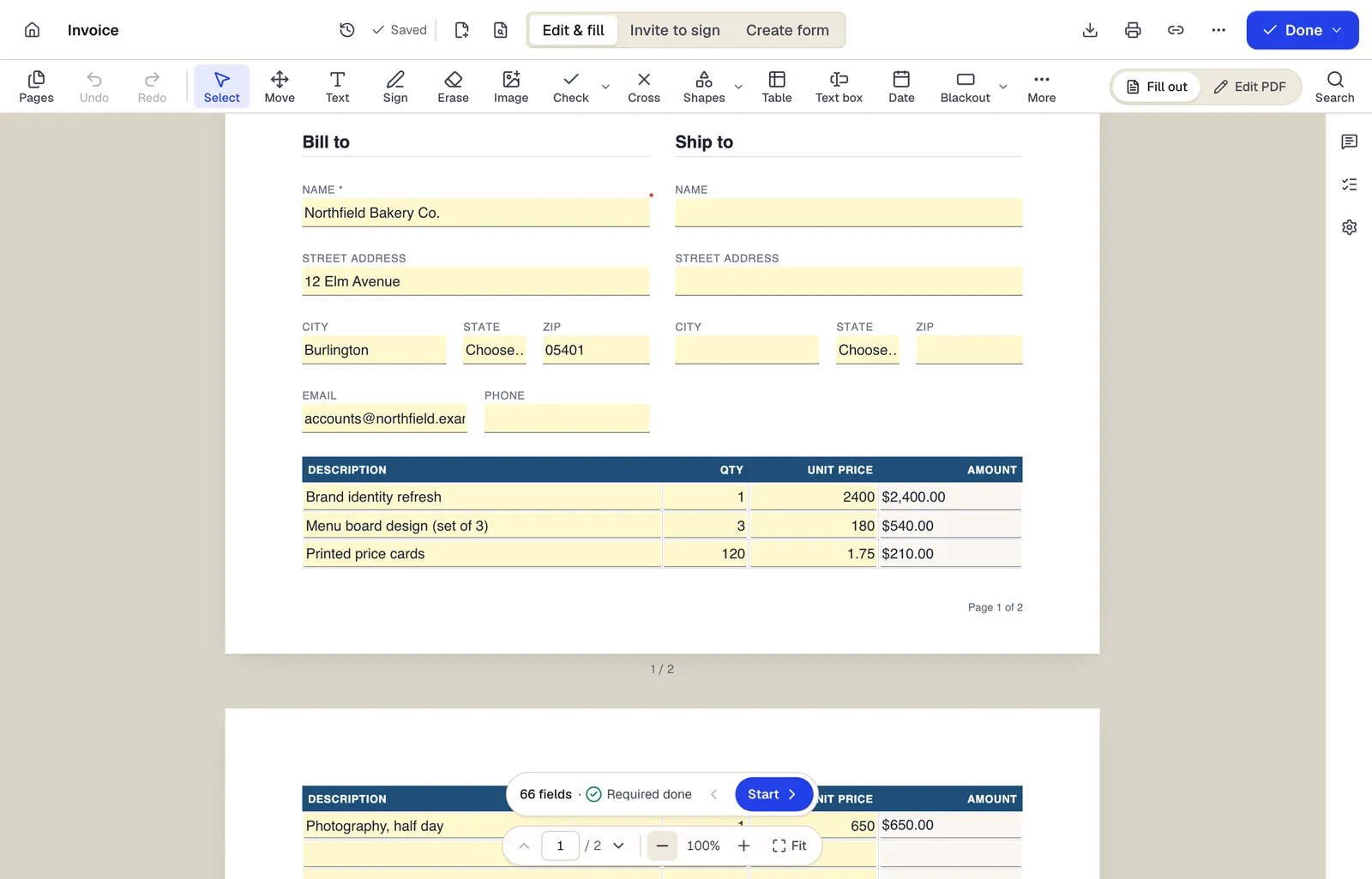
- Edit & fill, Invite to sign and Create form are three modes of the same editor
- Amounts are formula fields: they calculate as you type
- The field navigator counts what's left and jumps to the next field
The editor in Edit & fill mode on an invoice template. Sample content; names and companies are fictional.
Line by line
- 1
Line 1: Name
An entry is required. Individuals enter the name on their tax return. A sole proprietor or the owner of a single-member LLC that is a disregarded entity enters the owner's name here, not the business name.
- 2
Line 2: Business name
Your business, trade or “doing business as” name, or the disregarded entity's name, if different from line 1.
- 3
Line 3a: Tax classification
Check exactly one of seven boxes: individual/sole proprietor, C corporation, S corporation, partnership, trust/estate, LLC (with the code C, S or P for how it is taxed), or other. A disregarded LLC checks the box for its owner's classification instead of “LLC”.
- 4
Line 3b: Foreign partners, owners or beneficiaries
New in the March 2024 revision. Check it only if you checked partnership, trust/estate, or LLC taxed as a partnership, you are giving the form to a partnership, trust or estate in which you have an ownership interest, and you have foreign partners, owners or beneficiaries. Most individuals leave it blank.
- 5
Line 4: Exemptions
Enter an exempt payee code or FATCA exemption code only if the instructions say one applies to you, as with certain corporations and tax-exempt organizations. Individuals generally leave it blank.
- 6
Lines 5–6: Address
The address where the requester should mail your information returns.
- 7
Line 7: Account numbers
Optional. Some requesters ask you to list the account the form relates to.
- 8
Part I: TIN
Individuals generally enter their Social Security number; other entities their employer identification number. The TIN must match the name on line 1.
- 9
Part II: Sign and date
You certify under penalties of perjury that the information is correct. Cross out item 2 if the IRS has notified you that you are currently subject to backup withholding.
Fill it out with PDFBetter
Open the current W-9 from irs.gov in Fill PDF. The form's fields are detected, so you can type each line, tick your classification box and add your signature and date. Download the completed form with a free account, then flatten it if you want the entries fixed in place.
Ask the requester how they want to receive it. Requesters may accept electronically signed W-9s if their own system meets the IRS requirements described in the Instructions for the Requester of Form W-9; some still ask for a handwritten signature.
Send it securely
A W-9 contains your SSN or EIN, name and address, which is exactly what identity thieves want. Don't send it as an ordinary email attachment to an address you haven't verified. Upload it through the requester's secure portal, or protect the PDF with a password and share the password by phone or text.
Be wary of unexpected W-9 requests, especially ones claiming to be from the IRS. The IRS doesn't ask you to send it a W-9.
Tools used in this guide
- Fill PDFOpen the form, move through every field with Tab, fill it in, and download a completed PDF that keeps or locks your answers.
- Sign PDFCreate your signature once, click the signature line to place it, add initials or a date, and download the signed PDF.
- Protect PDFSet a password to open the file, optionally restrict printing, editing and copying, and download an encrypted PDF.
- Flatten PDFTurn every field, value and annotation into ordinary page content and download a PDF that cannot be changed by clicking.
Questions people ask
Do I send Form W-9 to the IRS?
No. Give it to the person or business that requested it. They use it to file information returns and keep it in their records.
Which revision of the W-9 is current?
The March 2024 revision, as of October 2026. The IRS's About Form W-9 page lists the current revision and any recent developments.
Should a single-member LLC use its own EIN?
If the LLC is a disregarded entity, the owner's name goes on line 1 and generally the owner's SSN or EIN goes in Part I. The LLC's name goes on line 2. The W-9 instructions cover exceptions.
Do I need to sign the W-9?
The form says you generally must sign the certification, with exceptions listed in the instructions for some payment types, such as mortgage interest and IRA contributions, where you need only provide your correct TIN.
What if I don't have a TIN yet?
The instructions explain how to apply for one and how to indicate on the form that you are waiting for a number.