
Internal Revenue Service (IRS) · United States (federal)
Form 9465: Installment Agreement Request
Current revision: Rev. September 2020 (checked on irs.gov, Oct 15, 2026)
Fill in IRS Form 9465 (Rev. September 2020) to request a monthly payment plan for taxes you owe. Line-by-line help, online alternative and where to send.
Filling needs no account. Downloading, printing or sending the completed form needs a free account — 3 downloads a month, no watermark.
Page reviewed
Form
9465
- Issued by
- Internal Revenue Service (IRS)
- Applies in
- United States (federal)
- Edition
- Rev. September 2020
Official source
PDFBetter is not affiliated with, endorsed by or acting for Internal Revenue Service (IRS). We open the form from irs.gov, and you fill it in our editor. Check the issuer's instructions before you file.
What it is
What Form 9465 is for
Form 9465 asks the IRS to let you pay a tax balance in monthly installments. If you owe $50,000 or less in combined tax, penalties and interest, you can usually set up a plan online for a lower fee instead. Interest and penalties continue to accrue until the balance is paid.
Fill it here
From irs.gov to your filled copy
- 1
Fetched from irs.gov
The agency's own, current PDF — not a retyped copy.
- 2
Opens in the editor
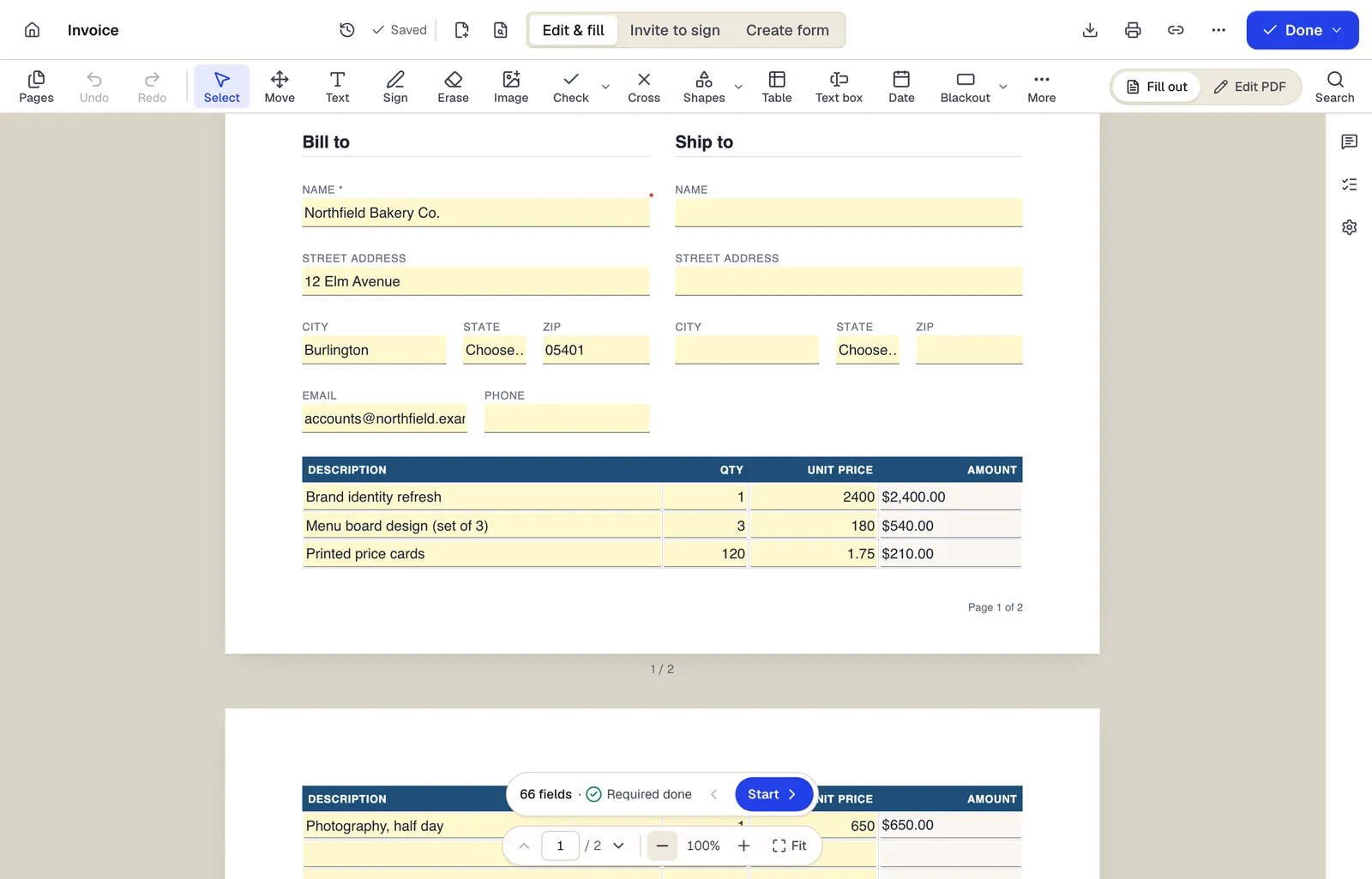
Fillable fields work as they are; on a flat page you type with text boxes.
- 3
Your filled copy
Download, print, sign or send it — the original stays untouched.
Who files it
- Individuals who can't pay a balance due on Form 1040 in full
- People responsible for an unpaid trust fund recovery penalty
- Owners of an out-of-business sole proprietorship with unpaid business taxes
- Taxpayers who prefer a paper request over the online application
What you need
- Your name, SSN, address and phone
- Total amount owed from your return or IRS notices
- The monthly amount you can pay and the day of the month (no later than the 28th)
- Bank routing and account numbers if paying by direct debit
- Employer information if paying by payroll deduction (Form 2159)
Line by line
How to fill out Form 9465
- 1
Lines 1–4 — Identity
Enter your name and SSN (and your spouse's for a joint return), check 1b if your address is new, and give the name and EIN of an out-of-business sole proprietorship if it applies.
- 2
Lines 5–9 — Amount owed
Enter the total on your return or notices, add other balances, subtract any payment you're making now, and enter the amount owed on line 9.
- 3
Line 10 — Guideline
Divide line 9 by 72 and enter the result. The instructions for lines 11a–11b explain how this figure affects whether you must also send a financial statement (Form 433-F).
- 4
Line 11 — Monthly payment
Enter the most you can pay each month. Larger payments mean less interest and penalty.
- 5
Lines 12–14 — Payment method
Choose the payment date, and enter bank details for direct debit or attach Form 2159 for payroll deduction.
- 6
Sign
Sign and date the form. For a joint balance, both spouses sign.
Where to send it
If you're filing it with your return, attach Form 9465 to the front of the return and send it to the address in your return instructions. If your return is already filed or you received a notice, mail it to the address in the Form 9465 instructions for your state (https://www.irs.gov/pub/irs-pdf/i9465.pdf). If you owe $50,000 or less, the Online Payment Agreement at https://www.irs.gov/payments/online-payment-agreement-application is usually faster and cheaper.
Filing rules change. Confirm the address or portal on irs.gov before you send.
Form 9465: questions people ask
Is there a fee?
Yes. The IRS charges a setup user fee that is lower for online applications and direct-debit plans, and can be waived or reimbursed for low-income taxpayers. The fees were last reduced on July 1, 2024; see the instructions for current amounts.
Should I file even if I can't pay?
Yes. File your return on time and request a payment plan. The failure-to-file penalty is much larger than the failure-to-pay penalty.
How long does the IRS take to respond?
The IRS usually lets you know within 30 days whether it approves the request. Keep making payments you can afford in the meantime.
Can I pay in full within 180 days instead?
If so, you may not need an installment agreement at all. The IRS offers short-term payment plans without a setup fee.
How should I send bank details securely?
The form includes your SSN and bank account number. Mail it, or use the online application. If you share a draft with a preparer, protect the PDF with a password.