
Guide · AI
How to connect Claude to your PDFs with MCP
Reviewed

Short answer
To connect Claude to your PDFs, create an agent key in PDFBetter under Settings → Agents (MCP), then add the MCP server https://pdfbetter.com/api/mcp/ with the header “Authorization: Bearer <your key>” to your client: one command in Claude Code, a config entry in Claude Desktop (through the mcp-remote bridge), or mcp.json in Cursor. Then ask for an outcome, such as “Merge my three latest invoices and give me the link”, and Claude calls PDFBetter's tools on your documents.
On this page (7)
Before you start
You need a PDFBetter account; agent access is included on every account plan, with 200 agent calls a month on Free and 5,000 on Pro. Each successful tool call counts once. The work a call triggers — exports, conversions, OCR pages, AI credits — uses the same allowances as doing it in the app.
MCP (Model Context Protocol) is an open standard that lets an AI assistant call tools on another service. PDFBetter's server speaks Streamable HTTP and signs in with a key in a header, so any client that supports remote servers with custom headers works.
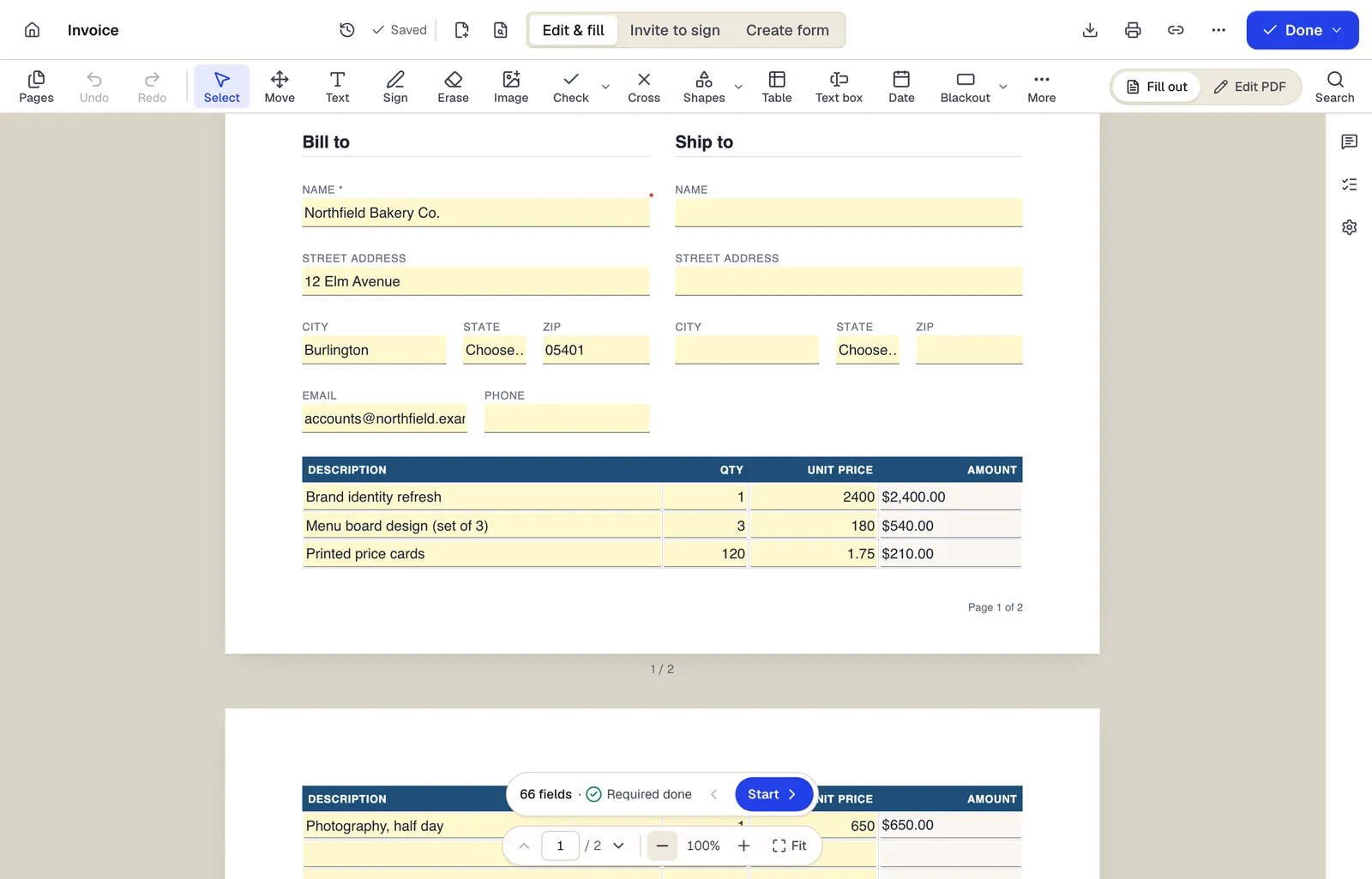
- Edit & fill, Invite to sign and Create form are three modes of the same editor
- Amounts are formula fields: they calculate as you type
- The field navigator counts what's left and jumps to the next field
The editor in Edit & fill mode on an invoice template. Sample content; names and companies are fictional.
Connect step by step
- 1
Create an agent key
Open Settings → Agents (MCP) and name the key after the client, such as “Claude Code on my laptop”. Tick only the permissions it needs — for example Read documents and Use AI — and copy the key. It starts with pb_mcp_ and is shown once.
- 2
Claude Code
Run: claude mcp add --transport http pdfbetter https://pdfbetter.com/api/mcp/ --header "Authorization: Bearer pb_mcp_…". Add --scope user to use it in every project.
- 3
Claude Desktop
Open Settings → Developer → Edit config and paste the snippet from PDFBetter's settings page into claude_desktop_config.json, then restart Claude. It runs the open-source mcp-remote bridge with npx, so Node.js must be installed.
- 4
Cursor
Add the server's URL and an Authorization header to ~/.cursor/mcp.json (or .cursor/mcp.json in a project). The settings page has the exact JSON.
- 5
Test it
Ask: “List my five most recent PDFBetter documents.” If you see your documents, the connection works.
Prompts that work well
Ask for a result, not a tool. “What is the notice period in the lease? Quote the page.” gets a cited answer. “Fill the W-9 with my company details and give me a download link” lists the form's fields, fills them and exports a new revision. “Extract the invoice number, date and total from these five invoices as CSV” uses data extraction if the key allows it.
Local files work too: the agent asks PDFBetter for an upload link, uploads the file and creates a document from it. Results come back as new documents, new revisions and download links that expire after a few minutes, so originals are never overwritten.
Keep it safe
Use one key per client so you can revoke one without breaking the others, and give each key the narrowest permissions that work. Revoking a key in Settings cuts off that client immediately. Keys belong in an MCP client or a server; PDFBetter refuses calls made from web pages.
Agents can't send signature requests, delete documents, change account settings or apply redactions. Workflow review steps wait for a person unless you explicitly allowed agent approval on that step.
If it doesn't connect
Check the URL keeps its trailing slash and the header reads exactly “Authorization: Bearer pb_mcp_…”. An authorization error means the key was mistyped or revoked; a permission error names the scope the key is missing. If AI answers say pages weren't read, those pages are scans without a text layer — ask the agent to OCR the document first.
Tools used in this guide
- Chat with PDFUpload a PDF and ask questions in plain language; every answer points to the pages it is based on.
- PDF to JSONChoose the fields you need, run it on one PDF or a whole batch, and check each value against the quote and page it came from before exporting.
- Fill PDFOpen the form, move through every field with Tab, fill it in, and download a completed PDF that keeps or locks your answers.
- Merge PDFDrop in two or more PDFs, set the file and page order, and download one combined PDF.
- OCR PDFUpload a scan, pick its language, and download a PDF that looks the same but lets you search, select and copy the text.
Questions people ask
Does Claude Desktop connect without the bridge?
Not yet. Claude Desktop's custom connectors sign in with OAuth, which PDFBetter doesn't offer yet, so the mcp-remote bridge sends your key instead.
Can Claude change my original PDFs?
No. Page tools create new documents, and filling fields or OCR save a new revision while earlier revisions stay in the version history.
What happens when I run out of agent calls?
Further tool calls are refused with a message until your plan period resets or you upgrade. Failed calls never count.
Does this work with ChatGPT or other assistants?
Any MCP client that supports remote Streamable HTTP servers with a custom Authorization header can connect. Clients that only support OAuth sign-in need a bridge such as mcp-remote.
Is my document sent to Anthropic?
Whatever the agent reads from a tool result goes to the model your client uses, under that provider's terms. Ask for cited answers or extracted fields instead of whole documents when you want to share less.