
Guide · Tax forms
How to fill out Schedule C
Reviewed

Short answer
Schedule C reports a sole proprietor's business income and expenses. Fill in the business details on lines A–J, gross receipts and other income in Part I, expenses by category in Part II, the home office deduction on line 30, and the net profit or loss on line 31; a profit goes to Schedule 1 (Form 1040), line 3, and Schedule SE, line 2. The Schedule C on irs.gov today is the 2025 edition; the 2026 edition, for returns due April 15, 2027, usually appears in December or January.
On this page (8)
Before you start
Schedule C is for a business you run as a sole proprietor: freelance or gig work, a side business, or a single-member LLC that hasn't elected to be taxed as a corporation. It attaches to Form 1040, 1040-SR or 1040-NR. File a separate Schedule C for each business, and a separate one for any statutory employee income from a W-2.
Check the edition. The PDF irs.gov posts today is the 2025 Schedule C, for 2025 returns. Draft 2026 instructions are on irs.gov/draft-tax-forms and describe a new line 16b for the business part of vehicle loan interest and line 16c for other interest; drafts can change and can't be filed. The line numbers below are from the 2025 form.
Gather the 1099s you received, your own income records, expenses by category, inventory figures if you sell products, a mileage log, and the square footage of your home and office.
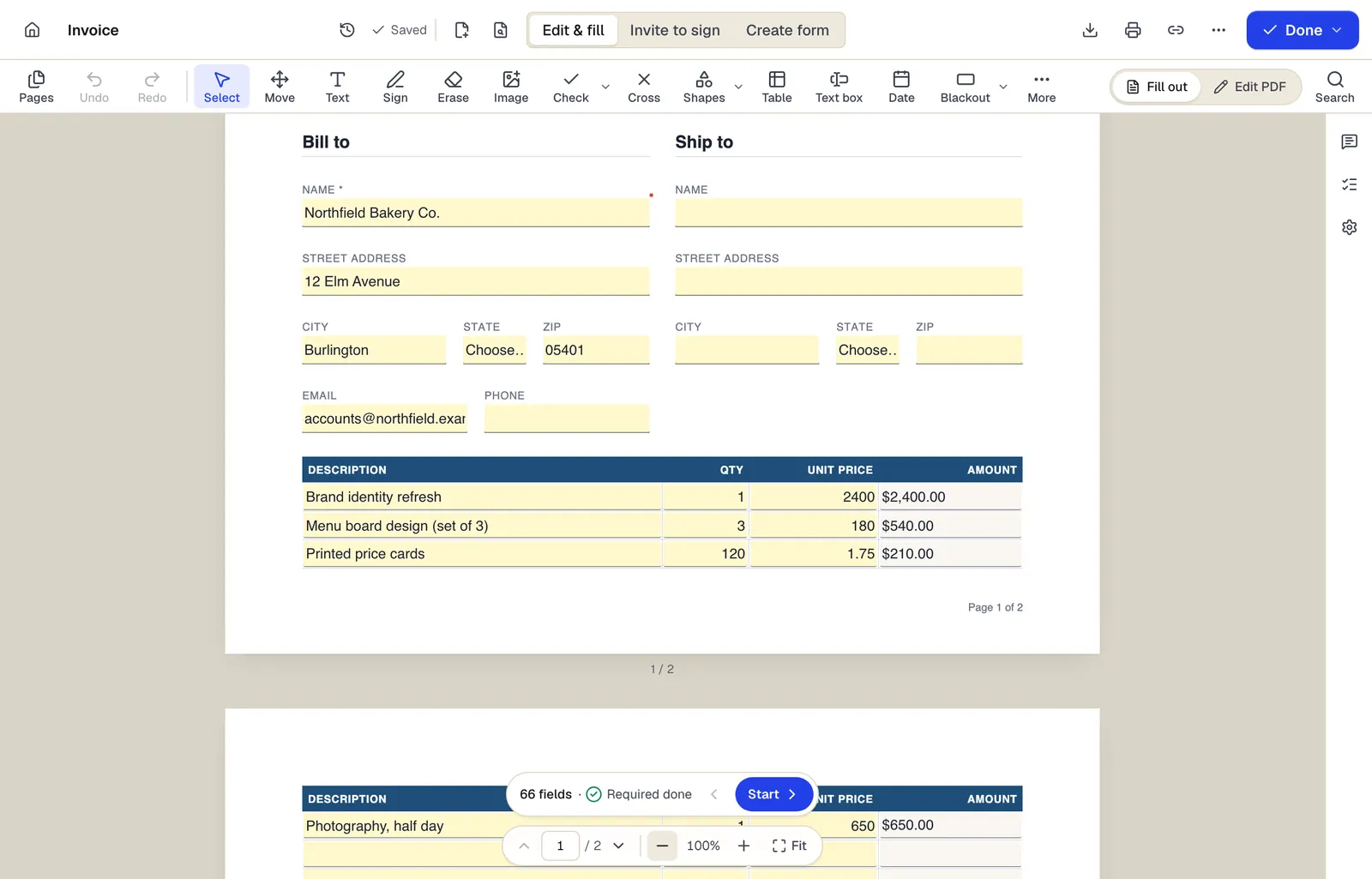
- Edit & fill, Invite to sign and Create form are three modes of the same editor
- Amounts are formula fields: they calculate as you type
- The field navigator counts what's left and jumps to the next field
The editor in Edit & fill mode on an invoice template. Sample content; names and companies are fictional.
Line by line
- 1
Lines A–E: the business
Your business or profession (A), the six-digit principal business code from the instructions (B), the business name if any (C), your EIN if you have one (D), and the business address (E).
- 2
Lines F–J: questions
Accounting method (F), whether you materially participated (G; if not, losses may be limited), whether you started or acquired the business this year (H), and whether you made payments that required you to file 1099s and did so (I–J).
- 3
Part I: income (lines 1–7)
Gross receipts on line 1, including the amounts on your 1099-NEC and 1099-K forms. Subtract returns and allowances (2) and cost of goods sold from Part III (4), add other income (6), and line 7 is gross income. Check the line 1 box only for statutory employee wages.
- 4
Part II: expenses (lines 8–27b)
Enter each expense on its own line: advertising (8), car and truck (9), commissions and fees (10), contract labor (11), depreciation and section 179 from Form 4562 (13), insurance (15), interest (16), legal and professional (17), office (18), rent (20a–20b), supplies (22), taxes and licenses (23), travel (24a), deductible meals (24b, generally 50%), utilities (25) and wages (26). Other costs are listed in Part V and carried to line 27b.
- 5
Lines 28–29: totals
Line 28 totals expenses before the home office, and line 29 is your tentative profit or loss.
- 6
Parts III–V
Cost of goods sold (lines 33–42) if you sell products, vehicle information (lines 43–47) if you claim car or truck expenses and don't file Form 4562, and other expenses (line 48).
Car and truck expenses (line 9)
You can deduct either the standard mileage rate or your actual costs. The rate is 70 cents per mile for 2025. For 2026 the IRS set two rates: 72.5 cents per mile from January 1 to June 30 and 76 cents per mile from July 1 to December 31, so keep your mileage log by date. Add business parking fees and tolls to the mileage amount.
With actual costs, put the business share of gas, oil, repairs, insurance and similar costs on line 9, depreciation on line 13, and lease payments on line 20a. You must use actual costs if you used five or more vehicles at the same time. To use the standard rate on a car you own, you must have used it in the first year the car was in service in your business; on a leased car, you must use it for the whole lease.
Either way, answer the vehicle questions in Part IV, or in Form 4562, Part V, if you claim depreciation or must file Form 4562 for another reason. Part IV asks whether you have evidence, so keep a log of dates, miles and the business purpose of each trip.
Home office (line 30)
The space must be used regularly and exclusively for business, with exceptions for inventory storage and certain daycare. This is a Schedule C deduction; employees can't claim it. Report home office costs only on line 30, using one of two methods for each home, chosen each year.
- 1
Simplified method
$5 per square foot of qualifying space, up to 300 square feet. Enter your home's total square footage and the business area on line 30 and use the Simplified Method Worksheet in the instructions. No Form 8829.
- 2
Form 8829 (actual expenses)
Figure the business percentage of your home, then apply it to costs such as mortgage interest or rent, real estate taxes, insurance and utilities, plus depreciation. The deduction can't create or increase a business loss; the excess carries over to next year. Form 8829, line 36 goes on Schedule C, line 30.
Net profit, Schedule 1 and Schedule SE
Line 31 is line 29 minus line 30. A profit goes on Schedule 1 (Form 1040), line 3, and on Schedule SE, line 2. For a loss, check box 32a if all your investment is at risk and report the loss in the same two places; check 32b and attach Form 6198 if some of it isn't, because the loss may be limited.
- 1
Schedule SE
Self-employment tax applies when your net earnings from self-employment (generally 92.35% of your profit, figured on Schedule SE, line 4c) are $400 or more. Each spouse with self-employment income files their own Schedule SE.
- 2
Schedule 2 and Schedule 1
The tax from Schedule SE, line 12 goes on Schedule 2, line 4, and half of it (Schedule SE, line 13) is a deduction on Schedule 1, line 15.
- 3
Estimated tax
No tax is withheld from self-employment income. The last 2026 estimated payment is due January 15, 2027 (Form 1040-ES). The return itself is due April 15, 2027, or October 15, 2027 with Form 4868.
Fill it out with PDFBetter
Open Schedule C (pdfbetter.com/forms/us/irs/schedule-c/), Form 8829 (/forms/us/irs/8829/), Form 4562 (/forms/us/irs/4562/) and Schedule SE (/forms/us/irs/schedule-se/) from PDFBetter's tax form library; each loads the IRS PDF in Fill PDF. Make sure the edition matches your return: until the 2026 forms are posted, these pages open the 2025 editions. Merge PDF puts your Form 1040, schedules and forms into one file in order before you print.
PDFBetter doesn't e-file. If you file on paper, sign Form 1040 by hand: the IRS says digital, electronic or typed-font signatures aren't valid on a paper Form 1040. The IRS instructions for Schedule C control; this guide is a general explanation, not tax advice.
Tools used in this guide
- Fill PDFOpen the form, move through every field with Tab, fill it in, and download a completed PDF that keeps or locks your answers.
- Merge PDFDrop in two or more PDFs, set the file and page order, and download one combined PDF.
- Print PDFSend your filled, signed or annotated PDF to a printer with everything positioned as it appears on screen.
- Share PDFCreate a link to your document, choose what people can do with it, and turn it off whenever you want.
Questions people ask
Do I report income that wasn't on a 1099?
Yes. The instructions say to report all income from your business from all sources, whether or not a payer sent a form.
I'm a statutory employee and I also freelance. One Schedule C or two?
Two. The instructions say statutory employee income can't be combined with self-employment income on one Schedule C. Statutory employee wages aren't subject to self-employment tax.
Which mileage rate do I use for 2026?
72.5 cents per business mile driven January 1 through June 30, 2026, and 76 cents per mile from July 1 through December 31, 2026, plus business parking and tolls.
Should I use the simplified method or Form 8829?
You choose each year. The simplified method is quicker and capped at 300 square feet. Form 8829 uses your actual costs and depreciation, which can come to more for a larger or more expensive home.
Can my LLC use Schedule C?
A single-member LLC reports on Schedule C unless it has elected to be treated as a corporation. A multi-member LLC files a partnership return instead.
My profit is small. Do I still need Schedule SE?
Only if your net earnings from self-employment (Schedule SE, line 4c) are $400 or more. The profit is still income on Schedule 1 either way.
Can I file the draft 2026 Schedule C?
No. Drafts on irs.gov/draft-tax-forms are for information only. Use the final 2026 form, which the IRS usually posts in December or January, or e-file.