
Internal Revenue Service (IRS) · United States (federal)
Form 1120: U.S. Corporation Income Tax Return
Current revision: Tax year 2025 (checked on irs.gov, Oct 28, 2026)
Fill in IRS Form 1120 (tax year 2025) for a C corporation: income, deductions, Schedule J tax, officer signature, e-file rule and the April 15, 2027 due date.
Filling needs no account. Downloading, printing or sending the completed form needs a free account — 3 downloads a month, no watermark.
Page reviewed
Form
1120
- Issued by
- Internal Revenue Service (IRS)
- Applies in
- United States (federal)
- Edition
- Tax year 2025
Official source
PDFBetter is not affiliated with, endorsed by or acting for Internal Revenue Service (IRS). We open the form from irs.gov, and you fill it in our editor. Check the issuer's instructions before you file.
What it is
What Form 1120 is for
Form 1120 is the annual income tax return of a U.S. C corporation. It reports the corporation's income, deductions, credits and tax, and it's filed even in a year with no taxable income. The PDF on irs.gov today is the tax-year 2025 edition; the 2026 form usually appears in December–January. A calendar-year 2026 return is due April 15, 2027, or October 15, 2027 with Form 7004, and a corporation that files 10 or more returns of any type in a calendar year must e-file it.
Form 1120 deadlines, 2027 filing season
Calendar-year 2026 Form 1120, any tax due, or Form 7004 to extend the time to file Source: irs.gov
Extended calendar-year 2026 Form 1120 Source: irs.gov
Dates already move past weekends and DC holidays, as the IRS rule says. Checked against irs.gov on October 28, 2026. See the full 2027 tax calendar.
Fill it here
From irs.gov to your filled copy
- 1
Fetched from irs.gov
The agency's own, current PDF — not a retyped copy.
- 2
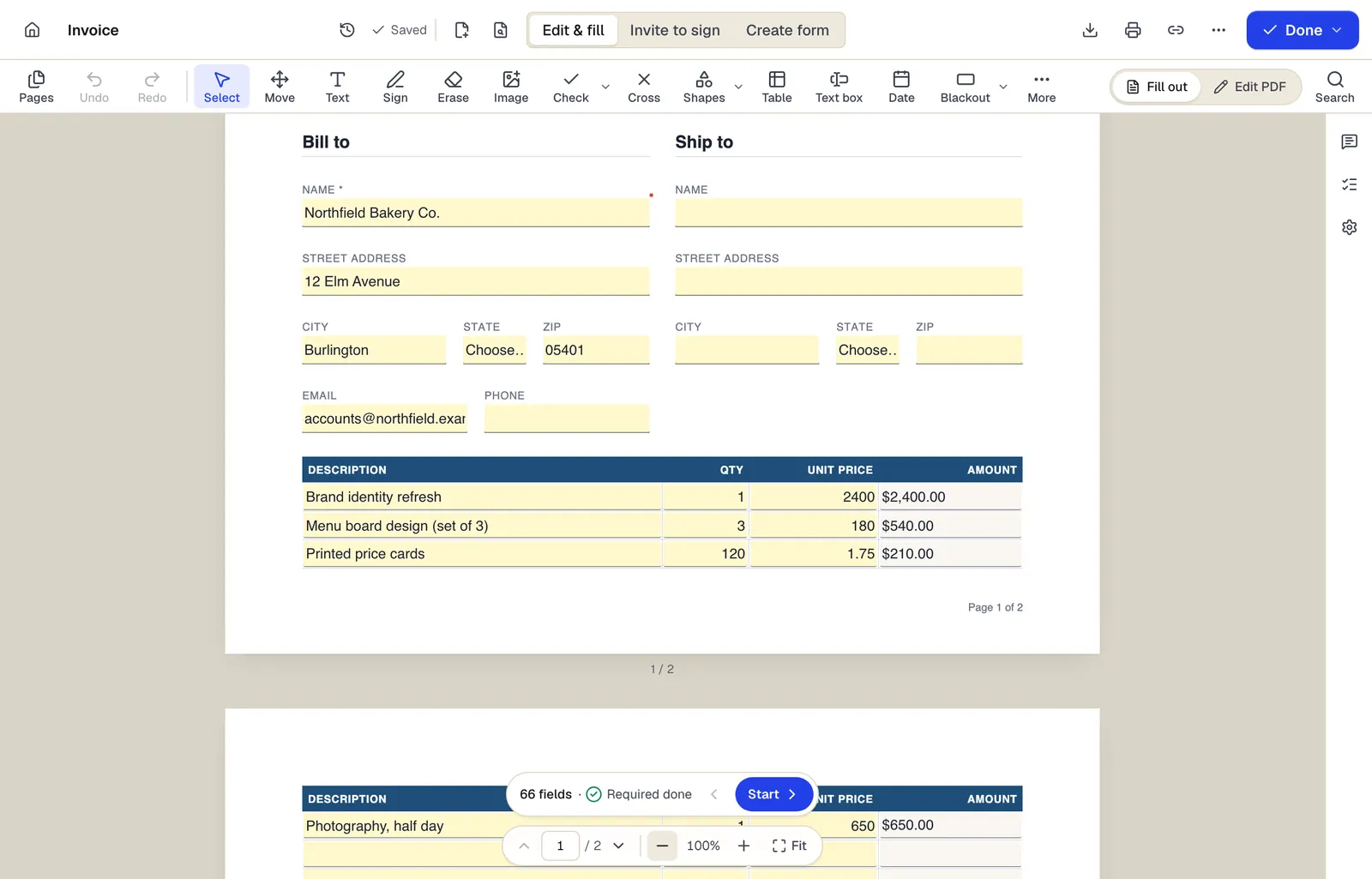
Opens in the editor
Fillable fields work as they are; on a flat page you type with text boxes.
- 3
Your filled copy
Download, print, sign or send it — the original stays untouched.
Who files it
- Domestic corporations that aren't exempt under section 501, whether or not they had taxable income
- Corporations in bankruptcy (the instructions include them)
- LLCs and other entities that elected to be taxed as a corporation and didn't elect S status
- Corporations filing a final return after dissolving (due by the 15th day of the 4th month after dissolution)
What you need
- EIN, legal name, address, date incorporated and total assets at year-end
- Gross receipts, returns and allowances, and cost of goods sold (Form 1125-A)
- Officer compensation (Form 1125-E) and other deductions by category
- Depreciation (Form 4562) and any net operating loss carryover
- Estimated tax payments and any amount paid with Form 7004
- Year-end balance sheet figures if Schedules L, M-1 and M-2 apply
- Bank routing and account numbers if you want a refund by direct deposit
Line by line
How to fill out Form 1120
- 1
Check the year first
The current PDF says “For calendar year 2025.” Use it for a 2025 return. For a calendar-year 2026 return, wait for the 2026 Form 1120.
- 2
Header — items A to E
Check boxes A1–A4 if they apply (consolidated return, personal holding company, personal service corporation, Schedule M-3). Enter the name, address, EIN (B), date incorporated (C) and total assets (D), and check E for an initial, final, name or address change.
- 3
Income — lines 1a–11
Enter gross receipts on line 1a, less returns on 1b, cost of goods sold on line 2, then dividends from Schedule C, interest, rents, royalties, capital gains and other income. Line 11 is total income.
- 4
Deductions — lines 12–29c
Enter officer compensation, salaries, rent, taxes, interest, depreciation and other deductions; line 27 is the total. Subtract it, then the net operating loss deduction (29a) and the Schedule C special deductions (29b).
- 5
Tax and payments — lines 30–37
Line 30 is taxable income. Figure the tax on Schedule J and carry it to line 31, payments to line 33, and any estimated tax penalty (Form 2220) to line 34. Line 35 is the amount owed, line 36 the overpayment.
- 6
Refund choices — line 37
Split an overpayment between a credit to 2026 estimated tax (37a) and a refund (37b). The 2025 form adds direct deposit fields: routing number (37c), account type (37d) and account number (37e).
- 7
Schedules C, J, K, L, M-1, M-2
Answer every Schedule K question. If total receipts and total assets are both under $250,000 (Schedule K, question 13), you don't have to complete Schedules L, M-1 and M-2.
- 8
Sign
An authorized officer signs, dates and enters their title. A paid preparer signs the Paid Preparer Use Only section and enters a PTIN.
Common Form 1120 mistakes
- Writing “See attached” or “Available upon request” in an entry space instead of completing it, which the instructions say not to do.
- Treating Form 7004 as more time to pay: interest runs on tax not paid by the regular due date.
- Mailing a paper return when the corporation files 10 or more returns of any type in the year and must e-file.
- Leaving the return unsigned or signed by someone who isn't an authorized officer (or a fiduciary such as a receiver or trustee).
- Using the 2025 PDF for a 2026 calendar-year return.
Where to send it
A corporation that files 10 or more returns of any type in a calendar year (income, employment, excise and information returns all count) must e-file Form 1120 through an IRS e-file provider; the IRS can grant a hardship waiver. Paper filers mail it to Kansas City or Ogden depending on the state of the principal business, total assets and whether Schedule M-3 is attached: https://www.irs.gov/filing/where-to-file-your-taxes-for-forms-1120. A calendar-year 2026 return is due April 15, 2027 (October 15, 2027 with a timely Form 7004). The return must be signed and dated by an authorized officer.
Filing rules change. Confirm the address or portal on irs.gov before you send.
Form 1120: questions people ask
Which year is this Form 1120 for?
The PDF on irs.gov today is the 2025 form, for calendar year 2025 or a tax year that begins in 2025. The 2026 version usually appears in December–January. PDFBetter opens whatever edition irs.gov posts when you open the page.
When is a fiscal-year return due?
Generally by the 15th day of the 4th month after the tax year ends. A corporation with a tax year ending June 30 files by the 15th day of the 3rd month. A due date on a weekend or legal holiday moves to the next business day.
What happens if we file late?
The 2025 instructions set the penalty at 5% of the unpaid tax for each month or part of a month the return is late, up to 25%. For returns required to be filed in 2026 that are more than 60 days late, the minimum is the smaller of the tax due or $525; the 2027 figure will be in the 2026 instructions when they're posted.
Who can sign Form 1120?
The president, vice president, treasurer, assistant treasurer, chief accounting officer, or another corporate officer (such as a tax officer) authorized to sign. A receiver, trustee or assignee signs instead when filing for the corporation.
Do small corporations need the balance sheet?
If total receipts and total assets at year-end are both under $250,000 (Schedule K, question 13), Schedules L, M-1 and M-2 aren't required. Instead you enter the cash and property distributions made during the year.
Can we get the refund by direct deposit?
Yes. The 2025 form added routing and account number fields on lines 37c–37e. You can also credit all or part of an overpayment to next year's estimated tax on line 37a.