Internal Revenue Service (IRS) · United States (federal)
Schedule SE (Form 1040): Self-Employment Tax
Current revision: Tax year 2025 (checked on irs.gov, Oct 28, 2026)
Fill in IRS Schedule SE (tax year 2025) to figure Social Security and Medicare tax on self-employment earnings of $400 or more. Line-by-line help.
Filling needs no account. Downloading, printing or sending the completed form needs a free account — 3 downloads a month, no watermark.
Page reviewed
Form
Schedule SE (Form 1040)
- Issued by
- Internal Revenue Service (IRS)
- Applies in
- United States (federal)
- Edition
- Tax year 2025
Official source
PDFBetter is not affiliated with, endorsed by or acting for Internal Revenue Service (IRS). We open the form from irs.gov, and you fill it in our editor. Check the issuer's instructions before you file.
What it is
What Form Schedule SE (Form 1040) is for
Schedule SE figures self-employment tax — the Social Security and Medicare tax self-employed people pay on their net earnings. You file it when net earnings on line 4c are $400 or more (or church employee income is $108.28 or more), and each spouse with self-employment income files their own. The PDF irs.gov posts is the 2025 edition, where up to $176,100 of combined wages and self-employment earnings is subject to Social Security tax; the draft 2026 instructions raise that to $184,500, and the 2026 schedule usually appears in December–January.
Schedule SE (Form 1040) deadlines, 2027 filing season
Last 2026 estimated tax payment, which should cover self-employment tax Source: irs.gov
File with your 2026 Form 1040 or 1040-SR (or request an extension with Form 4868) Source: irs.gov
File with an extended 2026 return if you filed Form 4868 by April 15 Source: irs.gov
Dates already move past weekends and DC holidays, as the IRS rule says. Checked against irs.gov on October 28, 2026. See the full 2027 tax calendar.
Fill it here
From irs.gov to your filled copy
- 1
Fetched from irs.gov
The agency's own, current PDF — not a retyped copy.
- 2
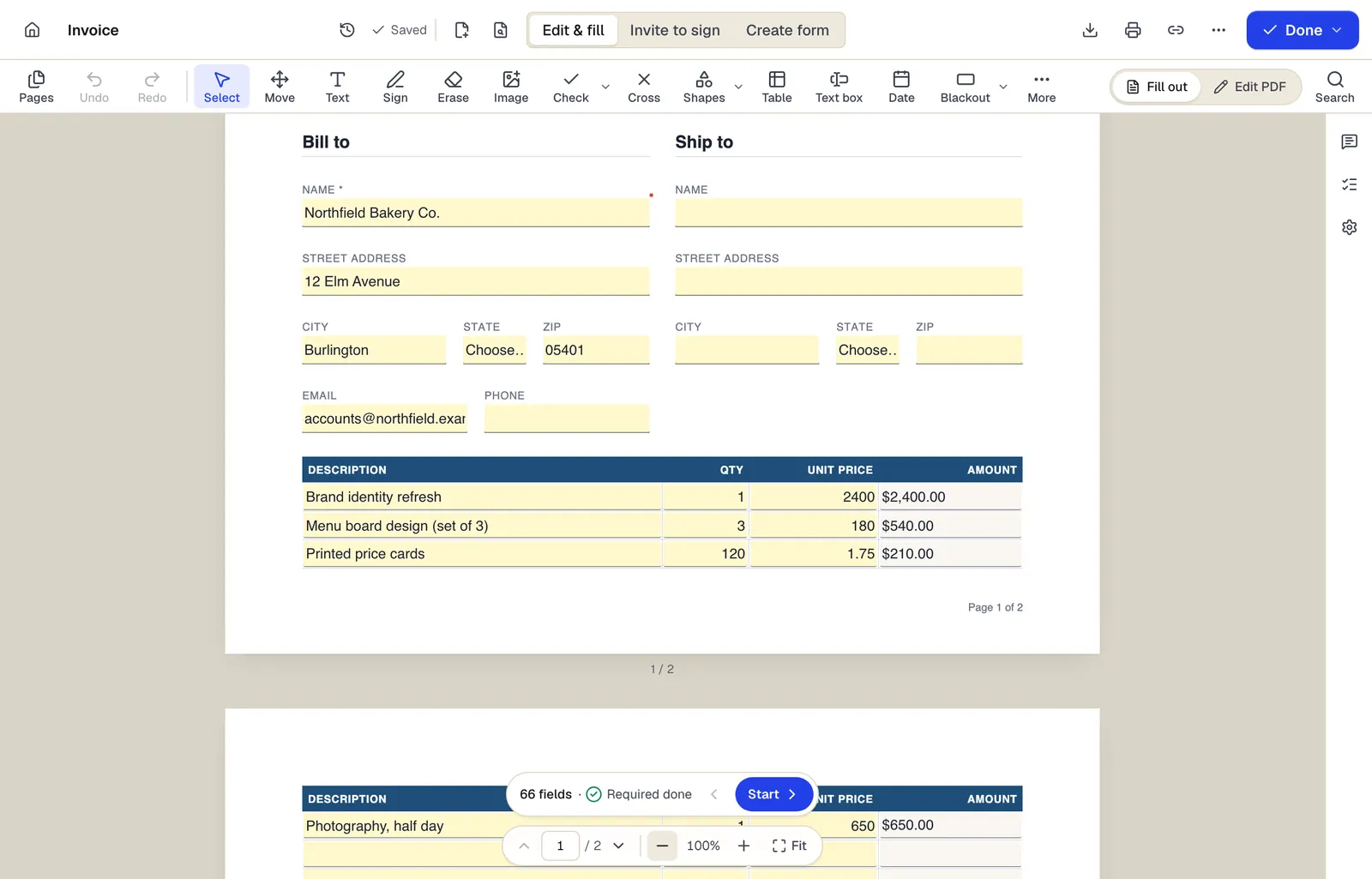
Opens in the editor
Fillable fields work as they are; on a flat page you type with text boxes.
- 3
Your filled copy
Download, print, sign or send it — the original stays untouched.
Who files it
- Sole proprietors, freelancers and gig workers with a Schedule C profit
- Partners with self-employment earnings on Schedule K-1 (Form 1065), box 14, code A
- Farmers with net farm profit on Schedule F
- Ministers and members of religious orders without an approved Form 4361 exemption
- Employees of churches that elected out of Social Security, with $108.28 or more in wages
What you need
- Schedule C, line 31, and Schedule F, line 34
- Schedules K-1 (Form 1065), box 14
- Forms W-2 (boxes 3 and 7) if you also had wages
- Form 4137 or Form 8919 if you had unreported tips or uncollected Social Security tax on wages
- Your self-employment history for the last 3 years if you use an optional method
Line by line
How to fill out Form Schedule SE (Form 1040)
- 1
Line A — Ministers
Check line A only if you have an approved Form 4361 exemption but still had $400 or more of other self-employment earnings.
- 2
Lines 1a–3 — Net profit
Enter net farm profit (1a), any Conservation Reserve Program payments if you get Social Security benefits (1b), and net profit from Schedule C, line 31, and K-1 box 14, code A (2). Combine on line 3.
- 3
Lines 4a–6 — Net earnings
Multiply line 3 by 92.35% on line 4a and add any optional-method amounts on 4b. If line 4c is under $400, stop — you don't owe the tax (unless you had church employee income on lines 5a–5b).
- 4
Lines 7–10 — Social Security part
Line 7 is the 2025 maximum of $176,100. Subtract Social Security wages and tips from your W-2s (8a–8d); line 10 is 12.4% of the smaller of line 6 or line 9.
- 5
Lines 11–13 — Medicare and totals
Line 11 is 2.9% of line 6. Line 12 is your self-employment tax for Schedule 2, line 4. Line 13, half of line 12, goes to Schedule 1, line 15, as a deduction.
- 6
Part II — Optional methods
Use lines 14–17 only if you qualify for the farm or nonfarm optional method, for example to keep earning Social Security credits in a low-profit year. The nonfarm method can be used no more than five times.
Common Schedule SE (Form 1040) mistakes
- Filing one Schedule SE for both spouses; each spouse with self-employment income files a separate one.
- Skipping lines 8a–8d when you also had wages, which can make you pay Social Security tax above the yearly maximum.
- Assuming retirees are exempt; the tax applies at any age, even if you already get Social Security or Medicare.
- Forgetting to deduct half of the tax on Schedule 1, line 15.
Where to send it
Attach Schedule SE to Form 1040, 1040-SR or 1040-NR (or Form 1040-SS) and file them together — by e-file or at the paper-return address for your state (https://www.irs.gov/filing/where-to-file-paper-tax-returns-with-or-without-a-payment). 2026 returns are due April 15, 2027, or October 15, 2027 with Form 4868. No tax is withheld from self-employment income, so you may need to make estimated payments with Form 1040-ES during the year.
Filing rules change. Confirm the address or portal on irs.gov before you send.
Form Schedule SE (Form 1040): questions people ask
Which year is this Schedule SE for?
The PDF irs.gov posts today is for tax year 2025; the 2026 version usually appears in December–January, and until then this page opens whatever irs.gov posts. Draft 2026 instructions are on irs.gov/draft-tax-forms.
I'm retired and on Social Security. Do I still owe it?
Yes, if your net self-employment earnings are $400 or more. The instructions say the tax applies no matter how old you are, even if you already get Social Security or Medicare.
I have a W-2 job too. Do I pay Social Security tax twice?
Only up to the yearly maximum. Enter your Social Security wages and tips on line 8a; once wages reach the maximum ($176,100 for 2025), the 12.4% part stops, though the 2.9% Medicare part doesn't.
My spouse and I run the business together. How many schedules?
If both of you have self-employment income, each files a separate Schedule SE, even on a joint return.
Does this affect my Social Security benefits?
Yes. The Social Security Administration uses Schedule SE information to figure your benefits.