
Internal Revenue Service (IRS) · United States (federal)
Schedule E (Form 1040): Supplemental Income and Loss
Current revision: Tax year 2025 (checked on irs.gov, Oct 28, 2026)
Fill in IRS Schedule E (tax year 2025) for rental property: rents, expenses and depreciation per property, plus K-1 income from partnerships and S corps.
Filling needs no account. Downloading, printing or sending the completed form needs a free account — 3 downloads a month, no watermark.
Page reviewed
Form
Schedule E (Form 1040)
- Issued by
- Internal Revenue Service (IRS)
- Applies in
- United States (federal)
- Edition
- Tax year 2025
Official source
PDFBetter is not affiliated with, endorsed by or acting for Internal Revenue Service (IRS). We open the form from irs.gov, and you fill it in our editor. Check the issuer's instructions before you file.
What it is
What Form Schedule E (Form 1040) is for
Schedule E reports income and expenses from rental real estate and royalties, plus your share of income or loss from partnerships, S corporations, estates and trusts shown on Schedules K-1. Landlords use Part I, with up to three properties per page and a column of rent and expenses for each. The PDF irs.gov posts is the 2025 edition; the 2026 version usually appears in December–January, and draft 2026 instructions are already posted. The total on line 41 goes to Schedule 1 (Form 1040), line 5.
Schedule E (Form 1040) deadlines, 2027 filing season
File with your 2026 Form 1040 or 1040-SR (or request an extension with Form 4868) Source: irs.gov
File with an extended 2026 return if you filed Form 4868 by April 15 Source: irs.gov
Dates already move past weekends and DC holidays, as the IRS rule says. Checked against irs.gov on October 28, 2026. See the full 2027 tax calendar.
Fill it here
From irs.gov to your filled copy
- 1
Fetched from irs.gov
The agency's own, current PDF — not a retyped copy.
- 2
Opens in the editor
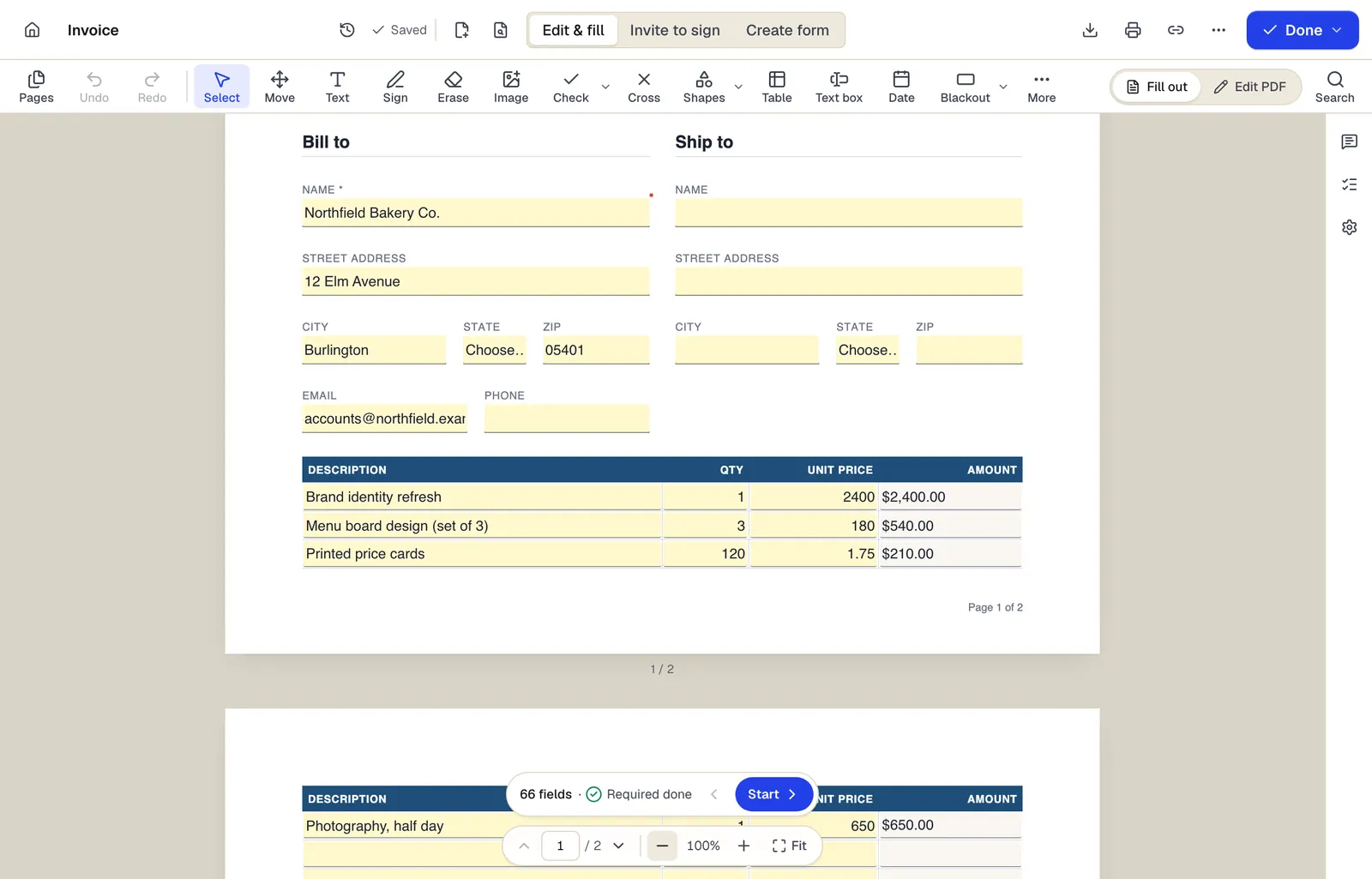
Fillable fields work as they are; on a flat page you type with text boxes.
- 3
Your filled copy
Download, print, sign or send it — the original stays untouched.
Who files it
- Landlords renting out houses, apartments, condos or vacation homes
- Owners of royalties from oil, gas, minerals, copyrights or patents
- Partners and S corporation shareholders with a Schedule K-1
- Beneficiaries of estates and trusts with a Schedule K-1 (Form 1041)
- Spouses who elect to run a jointly owned rental as a qualified joint venture
What you need
- The address and type of each property, and its fair-rental and personal-use days
- Rent received and records of each expense category
- Form 1098 for mortgage interest, and property tax bills
- Depreciation figures (Form 4562), with the purchase price split between land and building
- Any Forms 1099 you issued to contractors, and Schedules K-1 you received
Line by line
How to fill out Form Schedule E (Form 1040)
- 1
Lines A–B — Forms 1099
Answer whether you made payments in 2025 that required Forms 1099, and if so whether you filed them.
- 2
Lines 1a–2 — Each property
Enter each property's address and type code (1–8), and the number of fair rental days and personal use days. Check QJV only if you qualify as a qualified joint venture.
- 3
Lines 3–19 — Income and expenses
For each property column, enter rents (3) or royalties (4), then expenses: advertising, auto and travel, cleaning and maintenance, insurance, management fees, mortgage interest (12), repairs (14), taxes (16), utilities and depreciation (18).
- 4
Lines 20–22 — Result per property
Total the expenses, subtract from rents or royalties on line 21, and enter any deductible rental loss after the passive activity limits (Form 8582) on line 22.
- 5
Lines 23a–26 — Totals
Total rents, royalties, mortgage interest, depreciation and expenses across properties, then income (24) and losses (25). Line 26 is the total rental and royalty result.
- 6
Page 2 — K-1 income and summary
Report partnership and S corporation K-1 amounts in Part II, estates and trusts in Part III and REMICs in Part IV. Line 41 combines everything and goes to Schedule 1 (Form 1040), line 5.
Common Schedule E (Form 1040) mistakes
- Deducting improvements as repairs; costs that better, restore or adapt the property are depreciated, not deducted on line 14.
- Depreciating the land; split the cost between land and building and depreciate only the building.
- Deducting all expenses on a unit you also used as a home — more than the greater of 14 days or 10% of fair-rental days — when they may be limited.
- Reporting a rental where you provide significant services, such as maid service, on Schedule E instead of Schedule C.
- Taking a full rental loss without checking the passive activity rules; the special $25,000 allowance applies only below set income levels.
Where to send it
Attach Schedule E to Form 1040, 1040-SR or 1040-NR and file them together — by e-file or at the paper-return address for your state (https://www.irs.gov/filing/where-to-file-paper-tax-returns-with-or-without-a-payment). 2026 returns are due April 15, 2027, or October 15, 2027 with Form 4868. Schedule E isn't filed on its own.
Filing rules change. Confirm the address or portal on irs.gov before you send.
Form Schedule E (Form 1040): questions people ask
Which year is this Schedule E for?
The PDF irs.gov posts today is for tax year 2025; the 2026 version usually appears in December–January, and until then this page opens whatever irs.gov posts. Draft 2026 instructions are on irs.gov/draft-tax-forms.
I have more than three rentals. What do I do?
Fill in as many Schedules E as you need, three properties each, but complete lines 23a through 26 on only one of them, with the combined totals for all properties.
I rented my home for under 15 days. Do I report it?
If you used the unit as a home and rented it for fewer than 15 days in the year, don't report the rent and don't deduct rental expenses. If you itemize, you can still deduct allowable interest and taxes on Schedule A.
Can I deduct my rental loss?
Passive activity rules usually limit it. If you actively participated, a special allowance can let you deduct up to $25,000 of rental real estate losses ($12,500 if married filing separately and you lived apart all year), but it shrinks once modified AGI is over $100,000. Form 8582 figures the allowed amount.
Does a short-term rental go here or on Schedule C?
Rentals generally go on Schedule E. If you provide significant services to guests, such as maid service, report the activity on Schedule C instead.
How do I share it with my accountant?
Schedule E lists property addresses and your SSN. Share it through a password-protected link with an expiry date rather than an email attachment.