
Internal Revenue Service (IRS) · United States (federal)
Form 1099-INT: Interest Income
Current revision: Rev. January 2024 (checked on irs.gov, Oct 28, 2026)
Fill in IRS Form 1099-INT (Rev. January 2024) for 2026 interest: boxes 1–17, the $10 rule, recipient copies due February 1, 2027, and IRIS e-filing.
Filling needs no account. Downloading, printing or sending the completed form needs a free account — 3 downloads a month, no watermark.
Page reviewed
Form
1099-INT
- Issued by
- Internal Revenue Service (IRS)
- Applies in
- United States (federal)
- Edition
- Rev. January 2024
Official source
PDFBetter is not affiliated with, endorsed by or acting for Internal Revenue Service (IRS). We open the form from irs.gov, and you fill it in our editor. Check the issuer's instructions before you file.
What it is
What Form 1099-INT is for
Form 1099-INT reports interest of $10 or more that a bank, broker or business paid during the year, including Treasury and tax-exempt interest. The January 2024 revision is a continuous-use form, and the IRS says to use it for 2026 interest filed in early 2027; you type the year in the "For calendar year" box. Recipient copies are due February 1, 2027. Copy A printed from irs.gov can't be filed.
Form 1099-INT deadlines, 2027 filing season
Copy B to recipients Source: irs.gov
Paper Copy A with Form 1096 to the IRS Source: irs.gov
E-filed 1099-INT to the IRS Source: irs.gov
Dates already move past weekends and DC holidays, as the IRS rule says. Checked against irs.gov on October 28, 2026. See the full 2027 tax calendar.
Fill it here
From irs.gov to your filled copy
- 1
Fetched from irs.gov
The agency's own, current PDF — not a retyped copy.
- 2
Opens in the editor
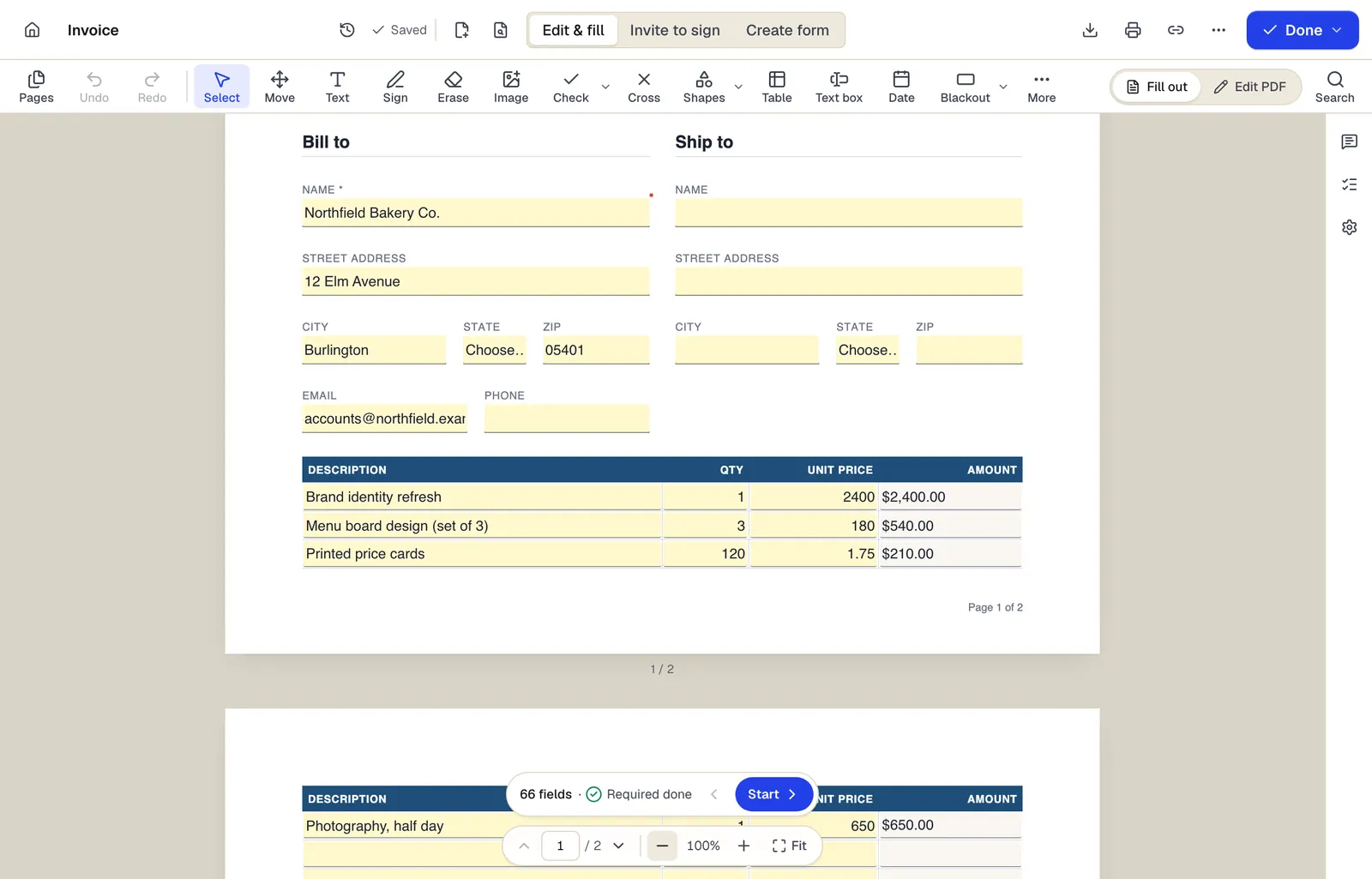
Fillable fields work as they are; on a flat page you type with text boxes.
- 3
Your filled copy
Download, print, sign or send it — the original stays untouched.
Who files it
- Banks, credit unions and brokers paying interest of $10 or more
- Businesses paying $2,000 or more of other interest in their trade or business, such as interest on delayed payments
- Payers of tax-exempt or U.S. Treasury interest
- Anyone who backup-withheld on interest, whatever the amount
What you need
- Your name, address, phone and TIN
- The recipient's name, address and TIN from Form W-9
- 2026 totals by type: taxable, U.S. Savings Bonds and Treasury, and tax-exempt interest
- Early withdrawal penalties, bond premium and market discount if they apply
- Federal, foreign and state tax withheld
Line by line
How to fill out Form 1099-INT
- 1
Year and parties
Enter 2026 in the "For calendar year" box, then your details, the recipient's name, address and TIN, and an account number if you file more than one form for them.
- 2
Box 1 — Interest income
Enter taxable interest not reported in box 3. Don't add a description.
- 3
Boxes 2–3
Box 2 is any early withdrawal penalty (don't subtract it from box 1). Box 3 is interest on U.S. Savings Bonds, Treasury bills, notes and bonds.
- 4
Boxes 4–7 — Withholding and foreign tax
Box 4 is backup withholding, box 5 investment expenses (single-class REMICs), and boxes 6–7 foreign tax paid and the country.
- 5
Boxes 8–9 — Tax-exempt interest
Box 8 is tax-exempt interest of $10 or more. Box 9 is the part from specified private activity bonds, also included in box 8.
- 6
Boxes 10–14
Market discount (10) if the holder elected to include it currently, bond premium (11–13), and the CUSIP number for tax-exempt bonds (14).
- 7
Boxes 15–17 — State
Enter the state, your state ID and state tax withheld if you file state copies.
- 8
Print recipient copies
Print Copy B for the recipient and Copy 2 for their state return. Don't file Copy A from this PDF.
Common Form 1099-INT mistakes
- Filing Copy A printed from irs.gov, which isn't scannable.
- Putting Treasury interest in box 1 instead of box 3.
- Reducing box 1 by the early withdrawal penalty instead of showing it in box 2.
- Reporting interest that belongs on Form 1099-OID or 1099-DIV, such as money market fund dividends.
- Truncating the recipient's TIN on Copy A; truncation is allowed only on recipient copies.
Where to send it
Furnish Copy B by February 1, 2027. File with the IRS by March 1, 2027 on paper (official red Copy A with Form 1096) or by March 31, 2027 if you e-file. If you have 10 or more information returns in total, you must e-file; the IRS's free portal is IRIS (https://www.irs.gov/filing/e-file-information-returns-with-iris). Paper forms can be ordered at https://www.irs.gov/businesses/order-paper-information-returns-and-employer-returns. State rules vary.
Filing rules change. Confirm the address or portal on irs.gov before you send.
Form 1099-INT: questions people ask
Why does the form say Rev. January 2024?
Form 1099-INT is a continuous-use form. The IRS's December 2026 instructions say to use the January 2024 revision for 2026 information filed in early 2027. You enter the year yourself.
What changed for 2026?
The $600 threshold for interest paid in the course of a trade or business, such as interest on a delayed payment, rose to $2,000. Bank and bond interest still uses $10.
Can I file Copy A printed from this PDF?
No. The attention page says it isn't scannable and a penalty may apply. E-file through IRIS or order official red forms.
Do I send a 1099-INT to a corporation?
Generally no. Corporations, tax-exempt organizations, IRAs and several other payees are exempt recipients, with exceptions for tax credit bonds.
Is it safe to send a 1099-INT by email?
It shows the recipient's TIN. Electronic delivery needs the recipient's consent. If they agree, use a password-protected link with an expiry date.