Internal Revenue Service (IRS) · United States (federal)
Schedule B (Form 1040): Interest and Ordinary Dividends
Current revision: Tax year 2025 (checked on irs.gov, Oct 28, 2026)
Fill in IRS Schedule B (tax year 2025): list interest and dividend payers over $1,500 and answer the Part III foreign account and foreign trust questions.
Filling needs no account. Downloading, printing or sending the completed form needs a free account — 3 downloads a month, no watermark.
Page reviewed
Form
Schedule B (Form 1040)
- Issued by
- Internal Revenue Service (IRS)
- Applies in
- United States (federal)
- Edition
- Tax year 2025
Official source
PDFBetter is not affiliated with, endorsed by or acting for Internal Revenue Service (IRS). We open the form from irs.gov, and you fill it in our editor. Check the issuer's instructions before you file.
What it is
What Form Schedule B (Form 1040) is for
Schedule B lists who paid you taxable interest and ordinary dividends, and asks about foreign financial accounts and foreign trusts. You need it when either total is over $1,500, and in some other cases — including any year you had a foreign account or a foreign-trust connection, whatever your income. The PDF irs.gov posts is the 2025 edition; the 2026 schedule usually appears in December–January, and draft 2026 instructions are already posted. Line 4 goes to Form 1040, line 2b, and line 6 to line 3b.
Schedule B (Form 1040) deadlines, 2027 filing season
File with your 2026 Form 1040 or 1040-SR (or request an extension with Form 4868) Source: irs.gov
File with an extended 2026 return if you filed Form 4868 by April 15 Source: irs.gov
Dates already move past weekends and DC holidays, as the IRS rule says. Checked against irs.gov on October 28, 2026. See the full 2027 tax calendar.
Fill it here
From irs.gov to your filled copy
- 1
Fetched from irs.gov
The agency's own, current PDF — not a retyped copy.
- 2
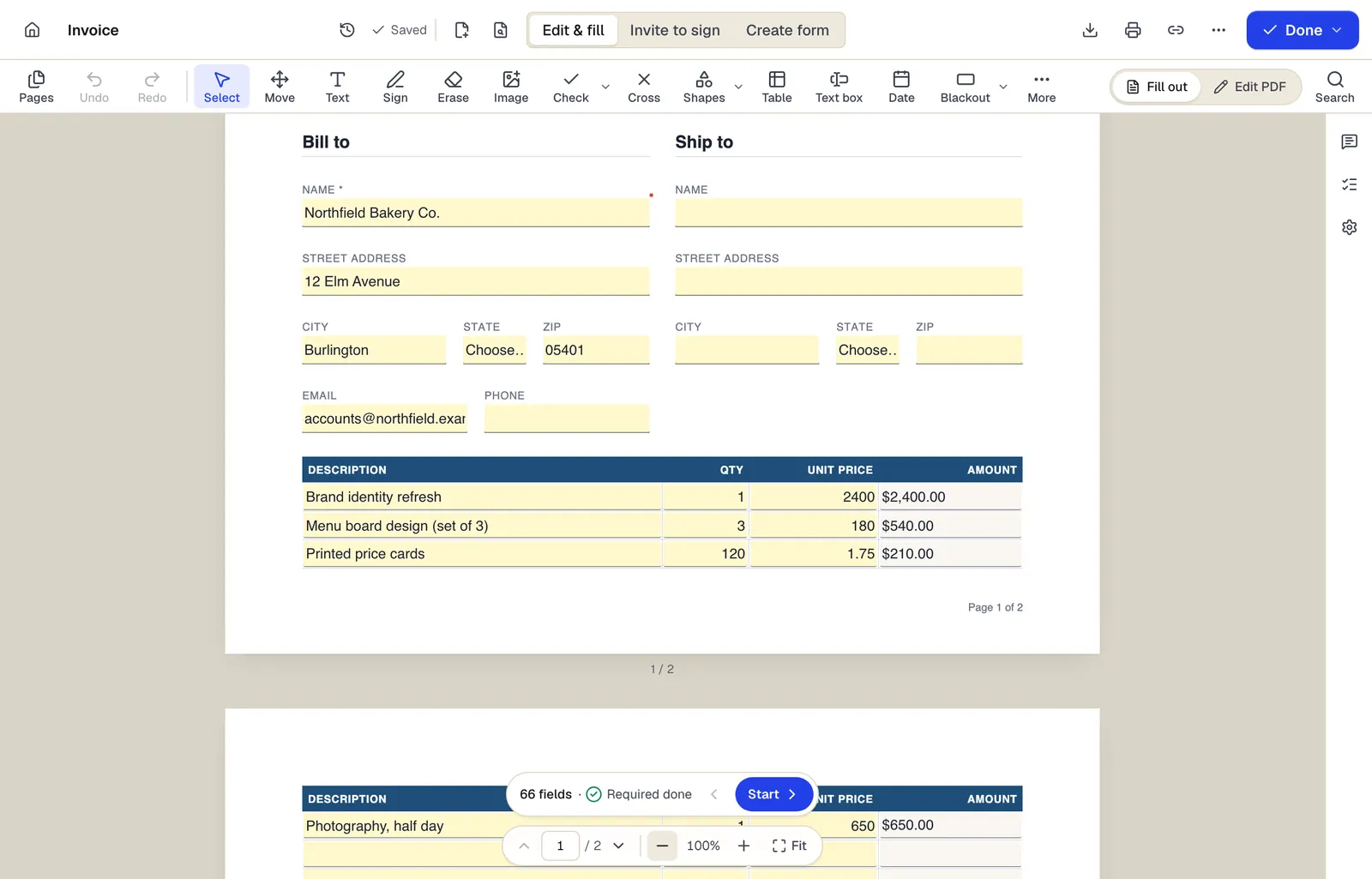
Opens in the editor
Fillable fields work as they are; on a flat page you type with text boxes.
- 3
Your filled copy
Download, print, sign or send it — the original stays untouched.
Who files it
- Anyone with more than $1,500 of taxable interest or ordinary dividends
- Anyone with a financial interest in, or signature authority over, a financial account in a foreign country
- People who received a distribution from, or were a grantor of or transferor to, a foreign trust
- Sellers who received interest on a seller-financed mortgage from a buyer who used the home as a residence
- People who received interest or dividends as a nominee, or exclude savings bond interest on Form 8815
What you need
- Forms 1099-INT, 1099-OID and 1099-DIV, or your brokerage's consolidated statement
- For a seller-financed mortgage, the buyer's name, address and SSN
- Form 8815 if you exclude interest on series EE or I savings bonds used for education
- A list of any foreign accounts and the countries where they're held
- Whether you must file FinCEN Form 114 (FBAR) or Form 8938
Line by line
How to fill out Form Schedule B (Form 1040)
- 1
Line 1 — Interest payers
List each payer and the taxable interest. For a brokerage 1099-INT, list the firm and the total. Put seller-financed mortgage interest first, with the buyer's name, SSN and address. Don't list tax-exempt interest.
- 2
Lines 2–4 — Interest total
Add line 1, subtract excludable savings bond interest from Form 8815 on line 3, and enter line 4 on Form 1040 or 1040-SR, line 2b.
- 3
Lines 5–6 — Ordinary dividends
List each payer and its ordinary dividends (box 1a of Form 1099-DIV). Enter the line 6 total on Form 1040 or 1040-SR, line 3b.
- 4
Line 7a — Foreign accounts
Answer whether at any time during 2025 you had a financial interest in or signature authority over a foreign financial account, then whether you must file FinCEN Form 114.
- 5
Line 7b — Countries
If you must file FinCEN Form 114, list the countries where the accounts are located. Attach a statement if you need more space.
- 6
Line 8 — Foreign trusts
Answer whether you received a distribution from, or were the grantor of or transferor to, a foreign trust. If yes, you may have to file Form 3520.
Common Schedule B (Form 1040) mistakes
- Answering “No” on line 7a because you don't need to file an FBAR; check “Yes” for any foreign account interest or signature authority, even when no FBAR is due.
- Attaching FinCEN Form 114 to the tax return instead of filing it electronically with FinCEN.
- Listing tax-exempt interest on line 1; it goes on Form 1040, line 2a.
- Leaving out the buyer's name, address and SSN for seller-financed mortgage interest, which can bring a $50 penalty.
- Skipping Part III when interest or dividends are over $1,500.
Where to send it
Attach Schedule B to Form 1040 or 1040-SR and file them together, by e-file or at the paper-return address for your state (https://www.irs.gov/filing/where-to-file-paper-tax-returns-with-or-without-a-payment). 2026 returns are due April 15, 2027, or October 15, 2027 with Form 4868. FinCEN Form 114 isn't attached to the return: it's filed electronically with FinCEN, which sets its own due date (see FinCEN.gov).
Filing rules change. Confirm the address or portal on irs.gov before you send.
Form Schedule B (Form 1040): questions people ask
Which year is this Schedule B for?
The PDF irs.gov posts today is for tax year 2025; the 2026 version usually appears in December–January, and until then this page opens whatever irs.gov posts. Draft 2026 instructions are on irs.gov/draft-tax-forms.
My interest is under $1,500. Do I still need it?
Usually not, unless another condition applies — for example a foreign account, a foreign trust, seller-financed mortgage interest, nominee income or the savings bond exclusion.
When do I have to file an FBAR?
The Schedule B instructions say a U.S. person must file FinCEN Form 114 if the combined value of their foreign financial accounts was over $10,000 at any time during the year. The rules and exceptions are in the FBAR instructions at FinCEN.gov.
What if I should have filed an FBAR and didn't?
The instructions warn of a civil penalty of up to $10,000, and much larger penalties for willful failures. Form 8938 may also be required separately.
Can I list my brokerage once instead of every fund?
Yes. If you got a Form 1099-INT, 1099-OID or 1099-DIV from a brokerage, list the firm as the payer and enter the total from that form.